
JULY 2025: Please note that the Transition Year Unit is currently being transformed into a Transition Year Micro-Module, in line with the new Transition Year Programme Statement. The updated documents will be made available as soon as possible.
It is with great pleasure that we launch the 2nd edition of the Access Classics Transition Year Unit!! You will find old favourites and lots of new ideas for lessons and activities, including more language activities (we have changed the name from “Classical Studies” to “Classics” to reflect this). Huge thanks to everyone who gave feedback and offered ideas on how to improve the Unit for its 2nd edition!
We created the Access Classics Transition Year Unit in 2020 to facilitate second-level institutions in either introducing Classical Studies at TY level, consolidating their students’ learning of the subject from the Junior Cycle, or acting as a bridge into, or introduction to, the subject at Senior Cycle level. It has been wonderful to see how schools and teachers have used the Unit over the past four years, not only in Transition Year but also in after-school clubs and in teaching other subjects, taking advantage of the interdisciplinary nature of Classics.
Attached below are: A Teachers’ Manual and a complementary PowerPoint. The Teachers’ Manual gives lots of background information and guidance so that it can be taught by a non-specialist, and the PowerPoint contains printable versions of activities and worksheets (when necessary)!
Click on the images below to download free, printable copies of the resources. See the bottom of the page for some additional resources.
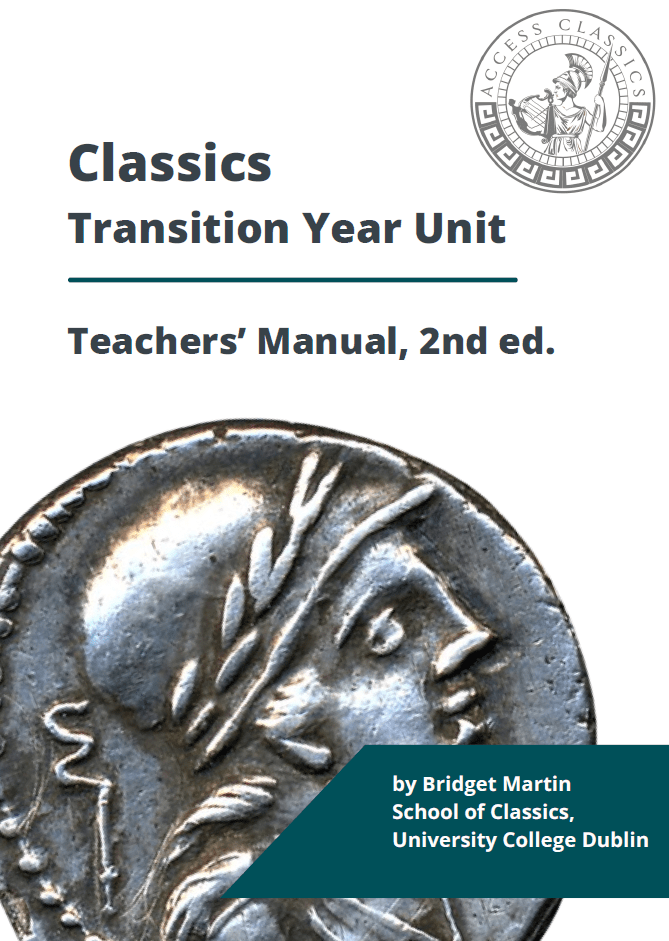
This manual for teachers contains background information, teaching plans, suggestions for lesson extensions and ideas for projects.
The manual is divided into four sections:
- What is Classical Studies? A case study of Ancient Cyprus
- People and the world around us
- Knowledge and advancements in the ancient world
- The past in the present
It is very helpful for us to know if some or all of the Unit is being used in a school and how many students it is reaching. If you intend to use the Unit, please let us know by dropping a line to bridget.martin@ucd.ie or access.classics@ucd.ie. Thanks!
This PowerPoint is created to complement the manual for teachers and contains additional information for students and easily printable worksheets.
We are very pleased to announce that we can now make available to teachers a Certificate of Completion for those students who have completed the Access Classics Transition Year Unit, or who have completed sections of it as part of a Unit. Just get in contact and we can tailor the certificate to your school!
Additional resources
Click on the images below to download a copy of the resources

2. PowerPoint on the Casino at Marino in Dublin. This short PowerPoint connects with Section 4 of the Unit: The Past in the Present by presenting students with an example of Classics in Ireland!
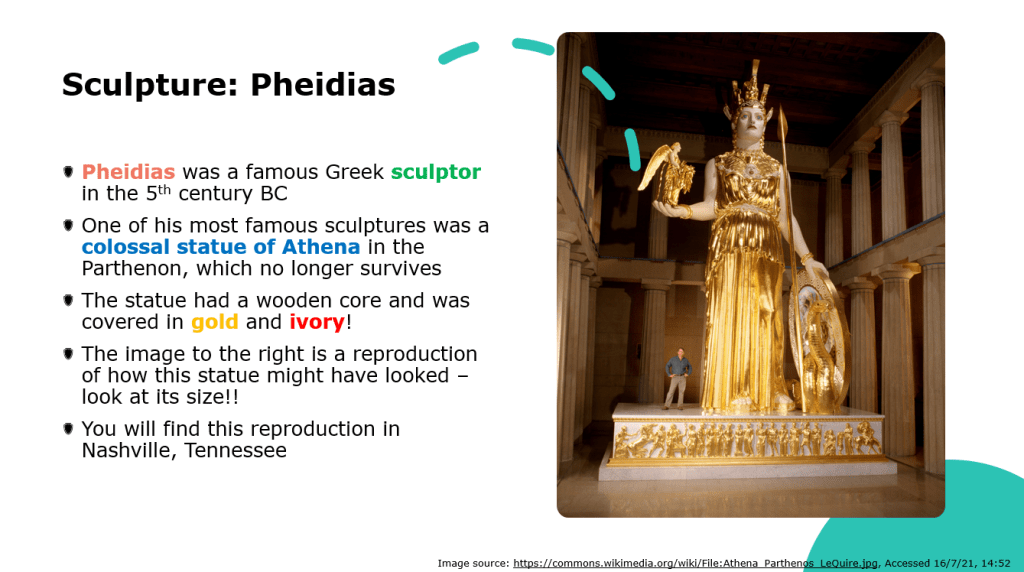
A short introductory PowerPoint on the Parthenon. This works as a brief introduction to the Parthenon, whose sculptures are discussed in Section 4.2: The ethics of museum artefacts.
PowerPoint on monstrous beasts and the hero Heracles for Section 2.3. This expands on some of the “monsters” encountered in the TY Unit and encourages students to see the importance of monsters, and particularly overcoming monsters, in ancient mythology.
Why use the Classical Studies TY Unit?
- The Manual for Teachers contains extensive lesson plans, materials, discussion topics and project ideas, all of which allow it to be taught by teachers who are not familiar with Classical Studies. This means that schools which do not, or cannot, currently offer Classical Studies at Junior Cycle or Senior Cycle can introduce it to their Transition Year students.
- As the Unit covers less common aspects of Classical Studies (see breakdown in Unit Outline or the Teachers’ Manual), it can be used to consolidate learning from the Junior Cycle, serve as an introduction to the subject at Senior Cycle, or act as a bridge between the Junior and Senior Cycle Classical Studies offerings.
- Classical Studies is a multidisciplinary subject encompassing, for example, literature, history, geography, art, architecture, language, archaeology, and philosophy. As such, it complements numerous subjects taken at both Junior Cycle and Senior Cycle level, most notably English, History, Art, Geography, and modern languages.
- As the Unit asks students to consider their own political, social, religious and cultural institutions and practices, as well as their relationship with their health and wellbeing, it ties in with various Indicators of Wellbeing (notably ‘responsible’, ‘connected’ and ‘respected’), and aspects of the Unit could be used for some of the allotted Wellbeing hours at Junior Cycle level.
- The Unit is flexible and user-friendly, meaning it can also be used for lunchtime Classics Clubs.
- The Unit can be taught fully in the virtual or physical classroom, or through blended learning. There are suggestions for fieldtrips, but these are supplementary to the lessons and not essential.
- Access Classics is delighted to facilitate teachers in teaching the Unit, for example through guest lectures or additional resources.
 Access Classics