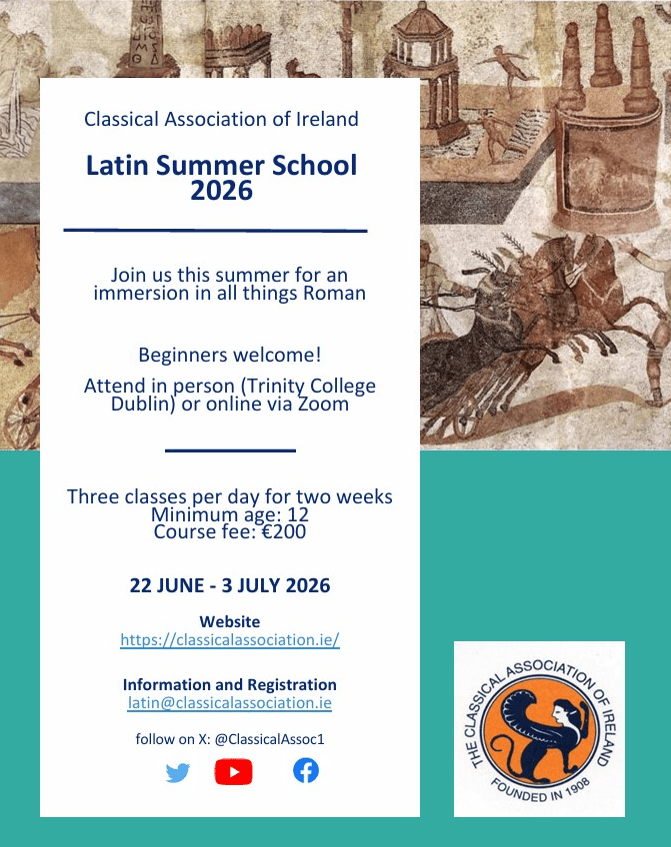
The popular Classical Association of Ireland Latin Summer school is back for 2026!
The Latin Summer School is designed for secondary school students between the ages of 12 and 18, with little or no knowledge of Latin and/or Classics, and offers an exciting opportunity to learn Latin through a two-week immersion course.
If you are not studying Latin or Classics, but you are interested in ancient languages and history, this is the place for you! Whether you are studying Classical Studies or the new Junior Certificate Classics or not, the Summer School offers an exciting opportunity to explore the culture of the Romans through their language. Perhaps you want to improve your language learning skills or understanding, communicating and writing in English? Or you are exploring your academic future? If you are you thinking about studying Classical Civilisation, Archaeology, Classical Languages, Ancient or Medieval History, Philosophy, Religion, History of Art, Romance languages in college, the CAI Summer school is a great place to start!
Over the course of two weeks (22 June – 3 July), you will immerse yourself in the language and history of Rome and engage in a variety of fun activities, led by experienced and passionate teachers. There will be interactive and online games, singing contests, Latin cartoons, and a bit of spoken Latin, too!
The Latin Summer School offers courses at Beginners level for students who have not studied Latin before. Each course has three 50-minute classes per day. All resources and learning materials are provided. After two weeks, students will be able to read simple Latin texts and have sufficient knowledge of the language to continue studying it independently or enter a higher-level course.
The Summer School will be conducted in a hybrid format, i.e. in person for those who choose to do so (venue: Trinity College Dublin), and online via Zoom.
Contact hours: three classes/per day for two weeks
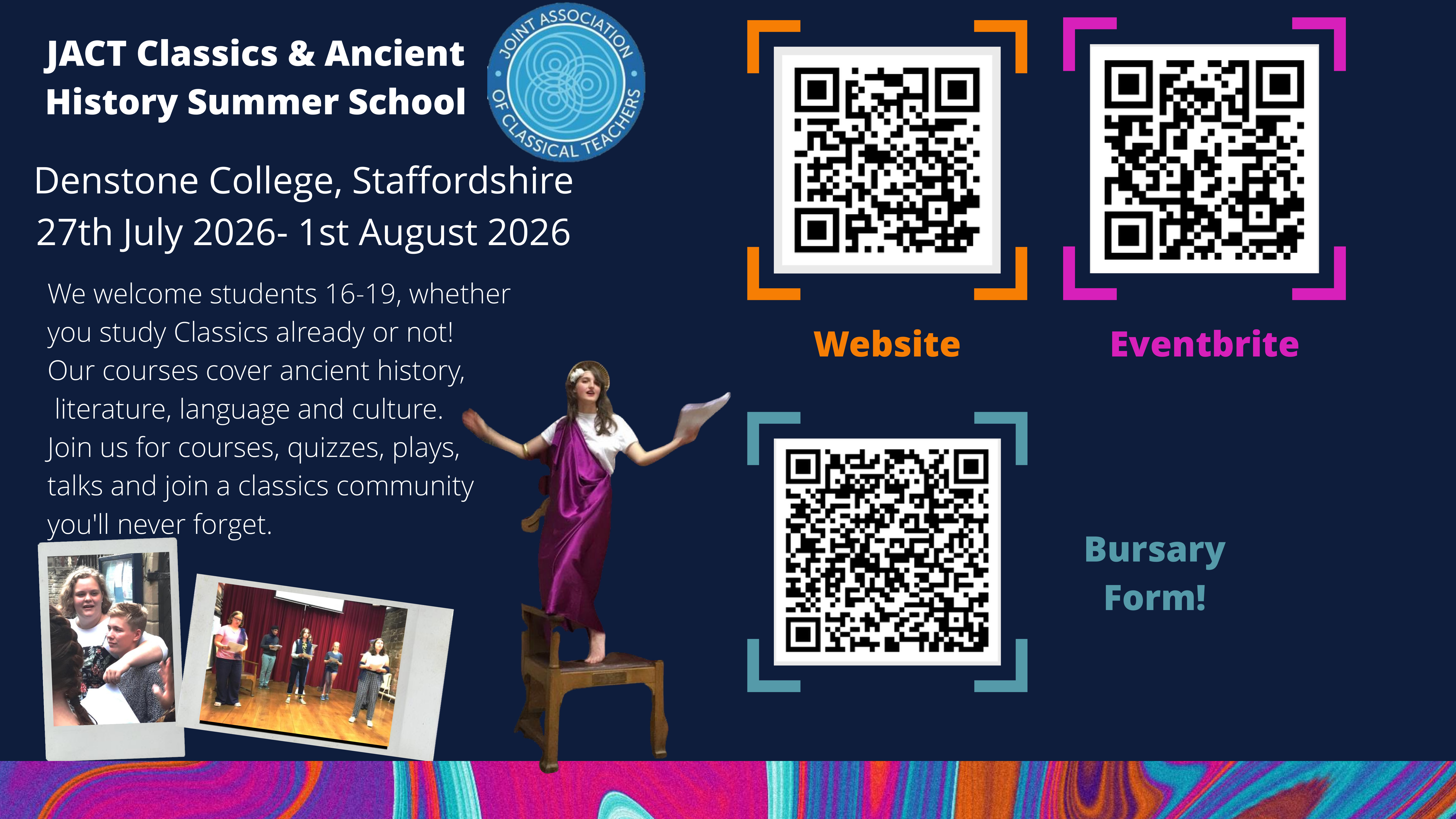
Our colleagues in the UK are running exciting summer Classics camps (students aged 16-19)!
Please see below for more information or click on the image above for QR codes.
Explore the world of ancient civilisations at the JACT Classics Camp, running from July 27th-August 1st 2026, at Denstone, UK, a historic setting in the heart of the Midlands. This program is ideal for students aged 16-19, from beginners to seasoned classicists. Through intensive study of ancient history, literature, language, philosophy, and archaeology, you’ll gain insights into the lives, thoughts, and legacies of the ancient world.
Participants will enjoy small, interactive classes with expert tutors, exploring subjects such as Homer, Greek and Latin literature, mythology, and ancient philosophy. Special workshops and talks on university entrance, theatre performances, and quizzes make learning fun and dynamic and open up pathways in Classics beyond A level. The program also offers opportunities for socialising and connecting with other Classics enthusiasts through evening events and group discussions.
The course fee starting at £420 covers tuition, meals, and accommodation, with generous bursaries available for eligible students. We also offer shuttles from nearby train stations to ensure all students can get to us easily. Don’t miss out on this unique opportunity to deepen your knowledge, make lasting friendships, and experience the classics in an unforgettable setting. You can secure your place by paying a small deposit on our Eventbrite page today.
If you would like more information, please see our website and the FAQ on our Eventbrite page, and feel free to contact our Course Director at jactclassicscamp@gmail.com with any other questions.
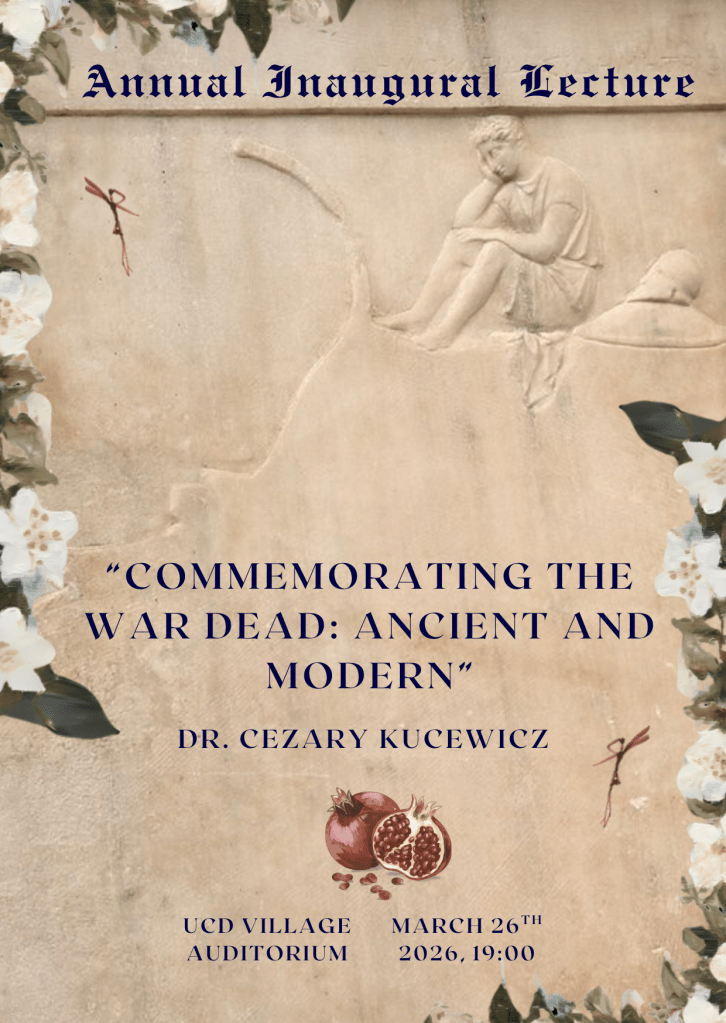
The UCD Classical Society, in conjunction with the UCD School of Classics, is delighted to announce that Dr Cezary Kucewicz (University of Gdańsk and University of Cambridge) will deliver this year’s Inaugural Lecture! Everyone is welcome, and you can register here (registering will help with planning the reception!).
The details of this year’s lecture are as follows:
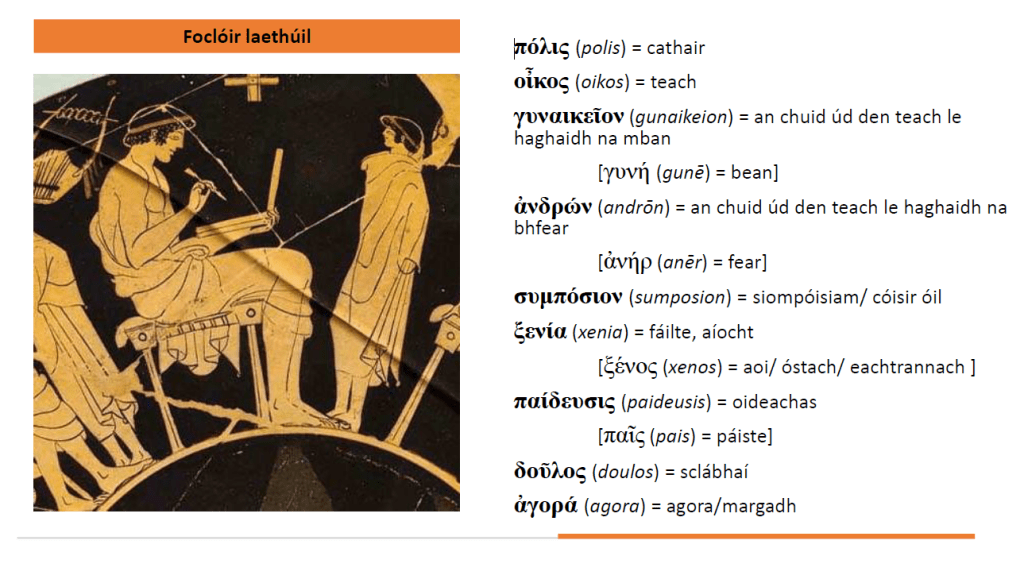
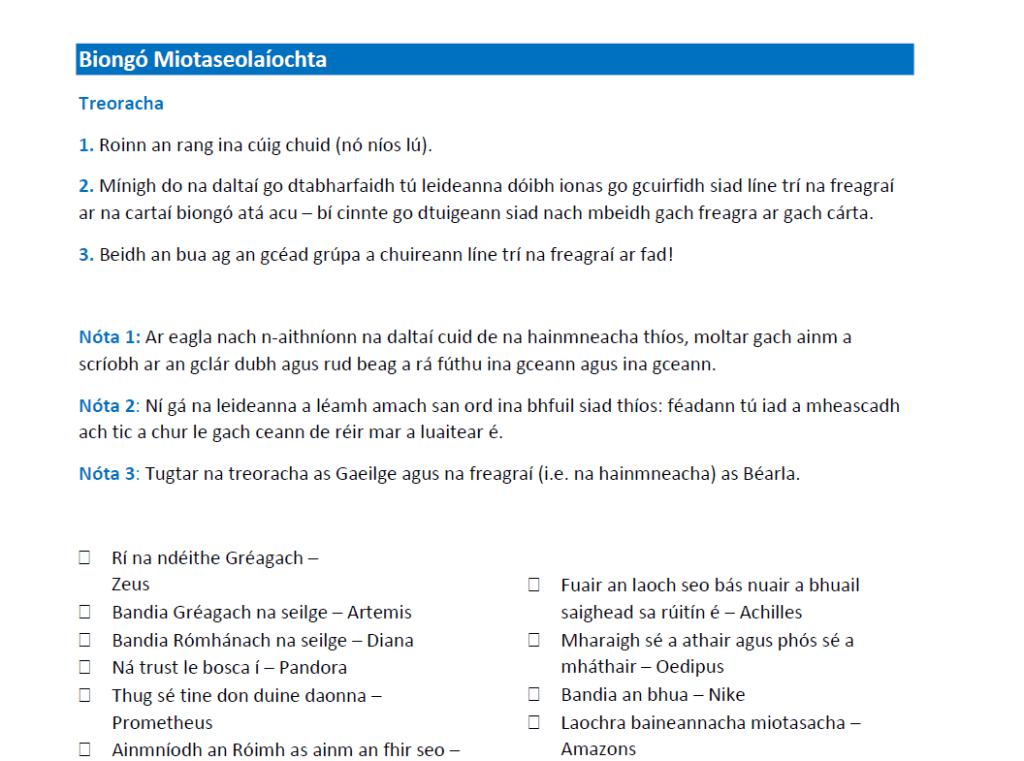
We are absolutely delighted to announce thatDr Lisa Doyle (Trinity College Dublin) has been working her magic, translating some of our Access Classics resources into Irish! Huge thanks, Lisa, for your amazing work!
The following three Junior Cycle (Strand 1) resources are now available as Gaeilge: (i) ancient Greek words connected with daily life; (ii) Greek mythology and the natural world today: A Challenge (PowerPoint); and (iii) mythology bingo. Just click on the images below to download your copy (the English language versions are available under the “Resources” tab)! Tuilleadh le teacht!
The new year brings lots of opportunities for everyone to engage with Classics in UCD!
1.Ancient Greek art and architecture (Lifelong Learning evening course)
As described on the UCD website: “This 8-week course will offer a visually rich and engaging introduction to the art and architecture of ancient Greece. From Bronze Age palaces to the grandeur of the Classical Parthenon and the expressive realism of Hellenistic sculpture, learners will explore how Greek visual culture evolved across time and space. Through discussion, close visual analysis, and consideration of archaeological and historical contexts, participants will gain insight into how art and architecture reflected and shaped ancient Greek society, religion, identity, and politics. No prior knowledge of ancient history or art history is required.”
The classes will take place in person on the UCD Belfield campus on Tuesdays (beginning 27 January), 6-8pm. There is a fee for this course, and booking is essential. Secure your place here.
2. UCD Classical Society Inaugural Lecture
Hotly anticipated every year, the 2026 UCD Classical Society Inaugural Lecture is set to be one of the best yet! On the evening of Thursday, 26 March, Dr Cezary Kucewicz (Cambridge & Gdansk) will speak in UCD on “Commemorating the War Dead: Ancient and Modern”, followed by a reception. Venue and time TBC, but keep an eye here for more information! This in-person lecture is free and open to the public.
3. UCD School of Classics Research Seminars
We are delighted to announce our line-up of research seminar speakers for Spring 2026. Times and locations (Belfield campus) will be announced prior to each lecture. Keep an eye on the Access Classics website or the School of Classics’ Instagram or Bluesky for details. Everyone welcome!
Dr Mengzhen Yue (Royal Holloway) “Rendering Adultery and Homosexuality in the Chinese Translation(s) of Aristotle’s Rhetoric“ [11 February 2026]
Dr Helen Dixon (UCD) “Music in Tibullus” [25 February 2026]
Eleanor Kellett (PhD candidate, UCD) “Body of Work – Classical Athenian Perceptions of Tattooed Thracian Women” [25 March 2026]
Dr Edward Herring (University of Galway) “Mourning Glory: honouring the dead on Apulian red-figure vases” [8 April 2026]
UPDATE (December 2025): The recording of this great event is now available here. Enjoy!
We’re delighted to share a message from our colleagues in Maynooth University about their wonderful Careers with Classics event:
Save the date! You are invited to the Careers with Classics 2025
Maynooth University, 17 September 2024 11am-1pm
Join us in person, Maynooth Campus Arts Annex (North Campus) or on Teams (link below)
Why study Classics in 2025?
The Department of Ancient Classics and Careers and Employability Service at Maynooth University are delighted to announce the fifth Careers with Classics event.
Join a panel of Maynooth graduates and international speakers as they share their experience with the world of Classics at third level and career path into the professional world. This event is designed for current secondary school pupils, particularly those in their final year as they prepare for Leaving Certificate, undergraduate and postgraduate students of Classics at all Irish third level institutions, teachers, and guidance counsellors. Fifth and sixth year classes especially welcome to join us in person or online!
If planning to attend the event in person with a class or group, we kindly ask you to let us know as soon as possible. The event will be conducted in a hybrid format, in presence for those who choose to do so (venue: Maynooth University north campus, Arts Annex), and online via Microsoft Teams (link below).
To register your interest or ask any questions, please contact Dr Cosetta Cadau (cosetta.cadau@mu.ie).
Firstly, a quick reminder to all the Classical Studies sitting the Leaving Certificate exams at the minute: all PowerPoints from the CAI-T Leaving Certificate Classical Studies Lecture Day are available here. Best of luck to everyone!
Secondly, over the next few months the Access Classics Transition Year Unit will be transformed into a Micro-module, in line with the new Transition Year programme. We are excited to work within the new programme statement to help bring Classics to even more schools! The current Unit will remain on the website until the new micro-module is available. Please send any queries about the Unit to bridget.martin@ucd.ie.
With the trees in leaf, it must be time to look back on another packed academic year of visits and events for Access Classics!
Each year, we try our best to accommodate as many school visits and events as possible as these are central to Access Classics’ mission to extend the reach of Classics in Ireland. We were delighted, then, to be able to meet more than 1,000 teachers, students and parents this academic year, and to welcome back old friends (such as the Dundrum College of Further Education) and meet new ones (such as St MacDara’s Community College). Once more, Access Classics worked very closely with the UCD Classical Museum, especially with Sasha Smith, to expand the amount of student visits, offer a wide range of activities and promote the ancient world through, for example, its artefacts, history, literature and languages. We had great fun introducing students to the wonders of the Museum and its handling collection alongside Greek language workshops and a range of Classics-related talks. Below are some highlights from the year!
CAI-T Leaving Certificate Lecture Day, 2025
Across a busy April, we had the enormous pleasure of collaborating with the Classical Association of Ireland Teachers (CAI-T) on two important events: the Leaving Certificate Lecture Day and the CAI-T Young Classicist Awards!
Photo credit: Delia Donohoe (2025)
We always love hosting the CAI-T Leaving Certificate Lecture Day in UCD, and this year was no exception. On 5 April, we welcomed ca 170 Leaving Certificate students and their teachers to the UCD campus to hear a range of lectures on topics connected with the Senior Cycle curriculum. Huge thanks to the UCD School of Classics’ lecturers who kindly gave up their Saturday morning/afternoon to present and to CAI-T’s Delia Donohoe for her help with organising and spreading the word about the day! All PowerPoints from the day are available by clicking on the “CAI-T lecture day 2025” tab above. The strands and topics covered are as follows:
1. “Greek and Roman funerary practices” (Dr Bridget Martin) Strand 4: Gods and Humans; Learning outcomes 4.9, 4.10 and 4.11
2.“Gods and Humans: Morality and Living Well in Plato’s Crito” (Dr Christopher Farrell) Strand 4: Gods and Humans
3.“Judging them by their enemies: Alexander & the Persians; Caesar & the Gauls” (Associate Professor Philip De Souza) Strand 3: Power and Identity
4. “Greek Tragedy: The Dionysia” (Dr Suzanne Lynch) Strand 2: Drama and Spectacle; Learning outcomes 2.4 and 2.5
5. “The Failure of Aeneas in Aeneid 2”(Dr Martin Brady) Strand 1: The World of Heroes; Learning outcomes: 1.2, 1.3, 1.5, 1.8, 1.9 and 1.10
6. “‘The same night awaits us all’: Death in Horace’s Odes” (Dr George Prekas) Strand 4: Gods and Humans; Learning outcomes 4.13 and 4.14
Classical Association of Ireland Teachers Young Classicist Awards, 2025
Access Classics’ Dr Bridget Martin joined Trinity’s Dr Charlie Kerrigan to judge the Awards this year, and, as ever, the range and creativity of the projects was amazing! The students were set the challenge of creating a project based on any aspect of Classics to compete in five awards categories: Junior Award (1st-3rd year), Transition Year Award, Senior Award (5th-6th year), Languages Award (for a project based on/with a component of Latin or Ancient Greek) and the Sustainability Award (for a project connected to Global Sustainability Goals). On 29 April, the finalists and their teachers and fellow students came to the beautiful, sunny UCD campus to display and present their projects. Dr Martin was on hand on the day to meet the finalists and have a chat about their projects! Under the steady hand of CAI-T’s Séamus O’Sullivan, the Awards went off without a hitch!
As every year, the students presented a dizzying array of projects, from beautiful poems, to paintings, hand-drawn comics, excellently researched essays, stop-motion animation, videos and original songs. As an added treat at the end of the Awards, students had the chance to visit the Classical Museum, take part in a role-play game or hear about Greek and Roman journeys to the Underworld! Well done to all students on their fantastic entries – we’re already looking forward to seeing what you create next year!
Spreading the word
The collaboration between Access Classics and the UCD Classical Museum bore fruit in 2024 in the form of an article in Museum Ireland (volume 30), arising from our paper at the Irish Museums Association’s “Education and Outreach Forum” (June 2023) in the beautiful surrounds of the Law Society of Ireland, Smithfield. In this article, entitled “Working Towards Inclusive Education with the UCD Classical Museum and Access Classics”, we discuss the aims, successes and challenges of our collaboration in attempting to increase access to and inclusion in Classics. Check it out here!
Access Classics was also delighted to speak to the UCD Widening Participation Outreach Network (9 October 2024) and at the Classical Association of Ireland Teachers annual conference in Maynooth (11–12 October 2024) about the successes and challenges of the programme. It’s always brilliant to chat with others engaged in outreach and, especially, with the teachers who are getting such amazing results from their Classics students at second level!
Access Classics even made its way into Dr Bridget Martin’s presentation at the conference “100 years of leaving certificate Greek and Latin: Histories, challenges, possibilities” (held in the Long Room Hub, Trinity, and organised by Dr Charlie Kerrigan and Mnemosyne Rice). In her contribution, entitled “Accessing the Classical languages at second level: Challenges and opportunities”, Bridget argued in part for the importance of outreach in spreading knowledge about ancient Greek and Latin, and thereby increasing access to the same.
Considering that the new specifications for Senior Cycle Greek and Latin are coming onstream in September 2025, this was a timely, uplifting and inspiring conference!
Coming soon!
Hot on the heels of the launch of its 2nd edition, the Access Classics Transition Year Unit is about to undergo another transformation! The National Council for Curriculum and Assessment announced a revised Transition Year Programme Statement (TYPS) in September 2024. Under the TYPS, Transition Year Units will be superseded by micro-modules. We are working very hard to re-imagine the Unit as a micro-module and will make this available (free of charge!) to all schools in time for the 2025/26 academic year. In the meantime, you can check out the Unit as it currently stand here.
Thank you!
Finally, a massive thank you to all the students, teachers, colleagues (in and outside UCD) and friends for their help and enthusiasm over the past year! As every year, we are inspired and humbled by the drive to expand access to Classics in Ireland, and we can’t wait to join in all over again in the next academic year!
This has been a week of great news for ancient Greek and Latin at second level!
Firstly, details of prescribed material for the new Ancient Greek and Latin specifications have been released, including the capstone texts (spoiler: Euripides’ Medea for Greek and Virgil’s Aeneid for Latin) and details on grammar needed for Ordinary and Higher Level. Secondly, the long-standing restriction on students studying combinations of Classical Studies, Latin and Ancient Greek at Senior Cycle has been removed, which means that students can now sit more than one of these subjects for the Leaving Cert! And finally, mock exams for the new Leaving Certificate ancient Greek and Latin specifications have been released (available here). Everything is now set for the new specifications to come on stream in September 2025! A huge amount of work lies behind all three of the above so huge congratulations to everyone involved!
UPDATE: All PowerPoint slides from the lecture day are now available under the “CAI-T lecture day 2025” tab.
The UCD School of Classics and the Access Classics team are delighted to announce that UCD will host the the annual CAIT lecture day for Leaving Certificate Classical Studies students this year, on Saturday, 5 April! UCD School of Classics lecturers will give talks based on topics from the Leaving Certificate curriculum, allowing students to expand and consolidate their knowledge, as well as enjoy a day on the beautiful UCD campus! The lectures will take place in Theatre M of the Newman Building. The provisional schedule is as follows (click on the image above for a pdf of the schedule):
10:00 Welcome 10:05 – 10:35 Greek and Roman funerary practices (Dr Bridget Martin) 10:40 – 11:10 Gods and Humans: Morality and Living Well in Plato’s Crito (Dr Christopher Farrell) 11:15 – 11:45 Judging them by their enemies: Alexander & the Persians; Caesar & the Gauls (Assoc. Prof. Philip De Souza) 11:50 –12:40 Lunch ***As most restaurants and cafes on campus are closed on Saturdays, please make sure to bring a packed lunch. Vending machines available in the building.*** 12:45 – 13:15 Greek Tragedy: The Dionysia (Dr Suzanne Lynch) 13:20 – 13:50 The Failure of Aeneas in Aeneid 2 (Dr Martin Brady) 13:55 – 14:25 “The same night awaits us all”: Death in Horace’s Odes (Dr George Prekas)




 Access Classics